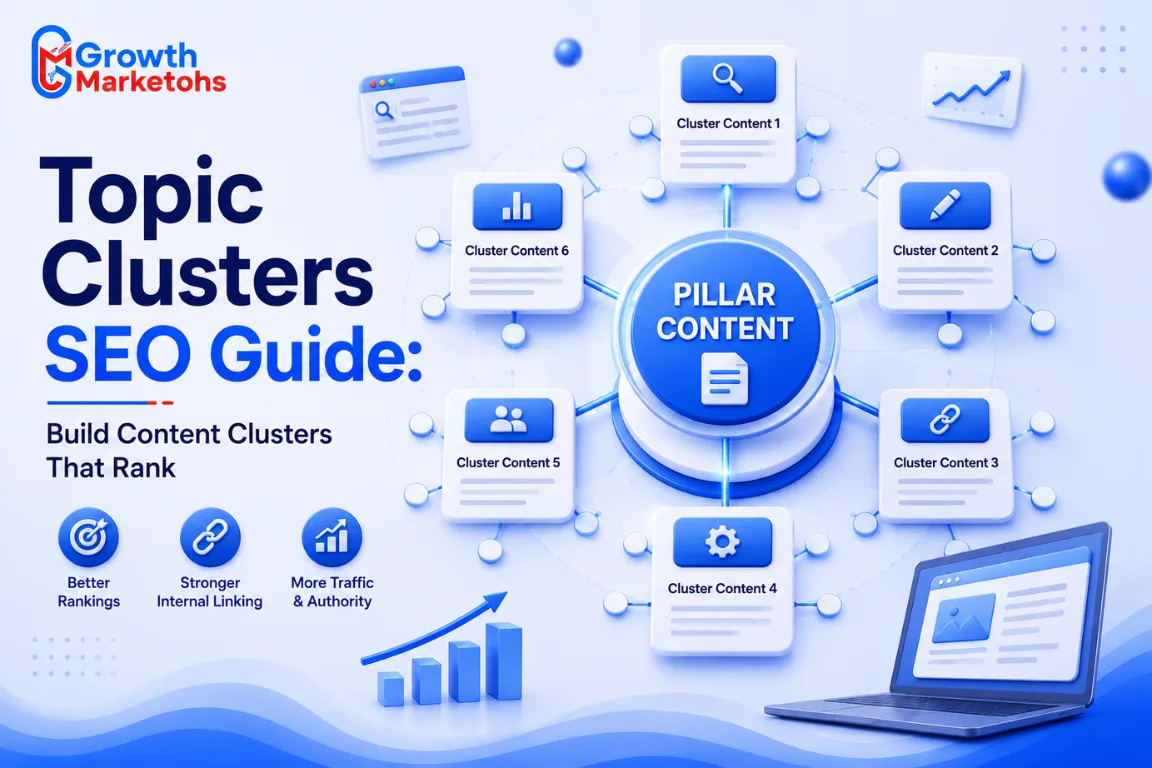
Topic clusters SEO is a content model that can be used to structure related content around a key pillar topic and several supporting cluster pages. Rather than creating disconnected blogs, this model builds a systematic content ecosystem that helps search engines understand topic associations, competencies, and relevance.
Powerful topic clusters enhance topical authority SEO, improve internal linking strategy, enhance user experience, and increase the likelihood of ranking for related keywords. With search engines focusing more on content depth and expertise in a given subject, topic clusters have now proven crucial to long-term SEO success.
They assist users in navigating information in a better way and enable websites to gain authority over a whole topic. As Google AI Overviews, AI Mode, and AI-powered search experiences become increasingly prominent, topic cluster SEO businesses are becoming more visible, ranking higher, and gaining a stronger advantage over competitors in organic search.
What Are Topic Clusters SEO?
Topic clusters seo is a form of content organization in which a general topic is backed by a series of articles that are related to one another and are interconnected through a hierarchical internal linking system.
The structure is generally comprised of:
- One pillar page
- Multiple cluster articles
- Strategic internal linking
- Semantic keyword coverage
- Multiple search intent layers
For example:
Pillar Page
SEO Services
Supporting Cluster Content
- Technical SEO Checklist
- Keyword Research Strategy
- Internal Linking Strategy
- Link Building Strategies
- Topical Authority SEO
- SEO Audit Checklist
- AI SEO Strategy
- Local SEO Guide
These pages, combined, form a systematic topic ecosystem that builds the topical authority and enhances search engine comprehension.
Why Topic Clusters SEO Matters in 2026
Today’s search engines have gone beyond keyword matching. Content depth, expertise, semantic relevance, and user satisfaction are now taken into account.
1. Strengthens Topical Authority
Establishing expertise on a particular topic is one of the greatest advantages of topic clusters seo. Search engines can have increased trust in your authority when more than one article is written on various facets of a matter. This helps improve rankings across a broader set of keywords and strengthens topical authority for SEO across your website.
2. Improves Internal Linking Structure
Topic clusters form an effective system of internal linking. Benefits include:
- Better crawlability
- Faster indexing
- Stronger authority flow
- Improved content discovery
An organized linking plan assists search engines to grasp connections among pages.
3. Supports AI Search Visibility
Search engines that use AI are more likely to favor content ecosystems that are authoritative rather than single pages.
Powerful topic clusters seo structures are beneficial:
- Improve AI citations
- Enhance AI Overview
- Conversational search discovery
- Enhance answer engine visibility
4. Improves User Experience
Users usually have several correlated questions.
Topics clusters help visitors browse related information that is more likely to get:
- Time on site
- Pages per session
- User engagement
- Trust signals
5. Creates More Ranking Opportunities
Topic clusters enable websites to rank for multiple keywords per page.
- Primary keywords
- Long-tail keywords
- Semantic variations
- Related search queries
This increases the total organic visibility.
6. Supports Long-Term SEO Growth
In comparison to short-term SEO strategies, topic clusters seo develops a content structure that is scalable and develops authority over time.
How Search Engines Understand Topic Clusters
Search engines have developed far beyond matching exact keywords. They now evaluate connections among the material, themes, objects, and user intent to determine whether a website demonstrates true expertise. That is why topic clusters and seo are so significant in the contemporary rankings. When interlinked content is posted on a site, search engines have a stronger indication of the site’s authority and topicality. Instead of considering pages individually, they assess the effectiveness of the overall content ecosystem in meeting users’ needs.
Semantic Relevance
Semantic analysis helps search engines to learn the relationship between topics. If you have several cluster articles that discuss supporting subtopics, Google can gain better insight into the depth and breadth of your knowledge.
Internal Linking Signals
Internal links serve as routes that enable search engines to learn about content connections. The close association between pillar pages and cluster material strengthens the relevance and authority of the topic.
Content Depth and Coverage
In more comprehensive coverage of a topic with many supporting articles, websites tend to exhibit greater expertise than those that use just one page.
User Engagement Signals
The time on page, page views, and content interaction metrics can help search engines determine whether the content ecosystem is valuable to users.
Entity Relationships
The latest search engines are becoming more dependent on brands, businesses, authors, and topics. Higher topic clusters will help search engines identify your site as having expertise in certain topics.
AI Search Understanding
The search engines offering AI-powered services include Google AI Overviews, AI Mode, and other websites’ search engine systems that analyze their topic relationships. Clear topic clusters enable AI systems to recognize authoritative links and enhance the visibility of AI-based search results.
Pillar Pages vs Cluster Content
The importance of knowing the distinction between pillar pages and cluster contents is vital to effective topic clusters seo execution.
| Element | Pillar Page | Cluster Content |
| Purpose | Broad topic coverage | Detailed subtopic coverage |
| Keyword Focus | Primary keyword | Related keywords |
| Length | Comprehensive | Specific and focused |
| Internal Links | Links to clusters | Links to pillar page |
| Goal | Build authority | Expand coverage |
A combination of these pages represents a whole content ecosystem.
How to Build Topic Clusters SEO That Rank
Developing effective topic clusters seo needs planning, structure and consistency.
1. Choose a Core Topic
Begin with a general theme that is directly related to your services.
Examples:
- SEO Services
- Digital Marketing
- Website Design
- Content Marketing
- AI SEO
It must have a broad topic that can sustain several cluster articles.
2. Create a Comprehensive Pillar Page
The pillar page is the main authority page.
To make a strong pillar page:
- Generalize on the subject
- Link to supporting clusters
- Address multiple search intents
- Provide a complete overview
Examples:
- SEO Services Guide
- AI SEO Services Guide
- Content Marketing Guide
The pillar page has served as the backbone of your topic clusters seo plan.
3. Identify Supporting Subtopics
Split the overall subject into areas. For SEO Services:
- Technical SEO
- Local SEO
- AI SEO
- Link Building
- Keyword Research
- SEO Audits
- Topical Authority
- Content Marketing
Each becomes a dedicated cluster article.
4. Build Strategic Internal Links
The foundation of topic clusters is internal linking. Best practices:
- Connect clusters with the pillar page
- Connect associated clusters
- Be descriptive in anchor text
- Avoid orphan pages
Having good internal linkage enhances topical authority, improves crawling, and prevents common SEO mistakes that weaken rankings.
5. Cover Multiple Search Intents
Successful topic cluster SEO strategies cover all stages of the user journey. Include content for:
- Informational intent
- Commercial intent
- Transactional intent
Examples:
Informational:
What is Technical SEO?
Commercial:
Best Marketing Search Engine Optimization Services.
Transactional:
Hire a Technical SEO Expert
This makes a rich content ecosystem.
6. Use Semantic SEO Principles
The present-day search engines interpret issues based on context.
Include:
- Related keywords
- Supporting concepts
- Industry terminology
- Semantic variations
This enhances the comprehension of topics
7. Publish Consistently
Power gains with predictability.
Search engines can identify experiences and relevance by publishing several related articles over time.
8. Add Real Experience and Case Studies
Google increasingly rewards experience-driven content backed by real campaigns, case studies, and results delivered by professional SEO services.
Include:
- Case studies
- Campaign results
- Practical examples
- Industry insights
This reinforces E-E-A-T signals and topical authority.
9. Refresh Existing Cluster Content
Content groups are intended to be dynamic.
Update:
- Statistics
- Internal links
- Examples
- Search intent alignment
- New material keeps it competitive
10. Measure Cluster Performance
Monitor the performance of the entire cluster rather than individual pages.
Monitor:
- Keyword growth
- Organic traffic
- Internal click paths
- Engagement metrics
- AI visibility
This would aid in maximizing your topic cluster seo strategy in the long run.
Tools to Build Topic Clusters SEO
To create effective topic clusters seo more than just writing related articles. To discover content opportunities, find semantic relationships, analyze search intent, enhance internal linking, and measure cluster performance, you need the right tools. The appropriate tools enable the business to develop topical authority, search visibility, and long-term SEO growth through structured content ecosystems. Regardless of whether you are creating clusters around SEO, digital marketing, AI SEO, or any other niche, these tools can help to make it much more efficient.
1. Ahrefs
One of the strongest tools for planning and expanding topic clusters is Ahrefs. It helps identify related keywords, content gaps, competitor topics, and ranking opportunities to support cluster content.
Key uses:
- Topic research
- Keyword clustering
- Content gap analysis
- Competitor content analysis
- Backlink opportunities
Ahrefs is valuable when developing a keyword research strategy and identifying supporting cluster opportunities.
2. SEMrush
SEMrush helps companies create content clusters by revealing relationships among keywords, search-intent potential, and topic gaps. Its Topic Research and Keyword Magic tools also come in handy when planning cluster structures.
Best features:
- Topic research
- Keyword grouping
- Search intent analysis
- Competitor content mapping
It aids in developing more strategic content ecosystems.
3. Google Search Console
Google Search Console provides firsthand information on how search engines perceive your content. It assists in determining the opportunities of growth of keywords and associated queries, which may be future cluster pages.
Useful for:
- Keyword expansion
- Search query analysis
- Topic performance tracking
- Content opportunity discovery
This renders it a crucial instrument in enhancing topic clusters seo in the long run.
4. Surfer SEO
Surfer SEO is used to optimize cluster content using semantic analysis and content suggestions. It identifies related words, content gaps, and enhancements to improve relevance.
Benefits include:
- Semantic keyword suggestions
- Content optimization
- Topic coverage analysis
- Competitor comparisons
Good optimisation of semantics enhances cluster performance.
5. AlsoAsked
AlsoAsked helps find the queries the user poses about a subject. Such questions are frequently perfect supporting-cluster articles, as they match the intent of the search.
Examples:
- What is technical SEO?
- Why are topic clusters important?
- What is internal linking?
Topical authority is reinforced by question-based content.
6. Google Trends
Google Trends helps identify emerging trends and rising search popularity in your field. This enables businesses to create clusters around issues before they get too competitive.
Best uses:
- Trend discovery
- Seasonal topic planning
- Content opportunity analysis
The use of trend-based clusters can yield early ranking advantages.
7. Screaming Frog
Screaming Frog can be useful in auditing internal linkages and cluster vulnerabilities. It helps ensure that pillar pages and supporting content are related appropriately.
Useful for:
- Internal link audits
- Crawl analysis
- Orphan page identification
- Content structure reviews
Effective topic clusters for seo require good internal linking.
8. ChatGPT and AI Research Tools
Artificial intelligence (AI) tools may be helpful in brainstorming cluster subjects and recognizing semantic associations and content structures. Human expertise should be the core of strategy, but AI tools can help hasten the planning and research process.
Helpful for:
- Topic ideation
- Content clustering
- Semantic keyword discovery
- Search intent mapping
They assist in effectively scaling content planning.
9. Mind Mapping Tools
Programs such as XMind, MindMeister, or Miro are used to illustrate connections between clusters prior to commencing content creation. The support and pillar pages mapping establishes a proper content structure.
Benefits:
- Topic visualization
- Content planning
- Cluster organization
- Internal linking strategy
Cluster structures can be more robust when doing visual planning.
10. Google Analytics
Google Analytics is used to gauge user interest in content groups. By analyzing user behavior, companies can determine which clusters generate the most traffic, interactions, and transactions.
Track:
- Organic traffic
- User journeys
- Time on page
- Conversion paths
The performance data will assist in the adjustment and growth of the successful content clusters.
How Growth Marketohs Builds Topic Clusters That Drive Rankings
Growth Marketohs is a growth-focused SEO agency that develops performance-driven topic clusters and SEO systems to enhance authority, rankings, and lead generation. The team generates full content ecosystems that interrelate pillar pages and support clusters, internal linking structures, semantic search engine optimization, and search intent optimization, rather than isolated blogs.
This strategy assists companies:
- Build topical authority
- Enhance AI search appearance
- Increase keyword coverage
- Strengthen internal linking
- Generate qualified organic traffic
Growth Marketohs assists businesses in developing scalable content structures that enable long-term search growth by leveraging content strategy, SEO expertise, and AI-driven search optimization.
Conclusion
In 2026, it will no longer be possible to publish something random and hope that it ranks. Search engines desire knowledge, relevance, organization, and exhaustive coverage of a topic. This is what has made topic clusters seo one of the most effective ways of gaining authority and long-term organic growth. With easier rankings, broader keyword exposure, enhanced user interaction, and improved AI search visibility, businesses that present content within structured topic ecosystems achieve stronger rankings.
With advances in Google AI overviews, AI mode, and conversational search, topic clusters will further assist search engines in surfacing expert knowledge.
Growth Marketohs is a leading SEO agency that helps businesses build topical authority through strategic content clusters, SEO services, content marketing services, advanced internal linking systems, and AI search optimization.
If your content isn’t building authority, driving rankings, or generating qualified traffic, it’s time for a smarter strategy. Growth Marketohs develops topic cluster SEO frameworks that help businesses improve topical authority, increase AI search visibility, and generate sustainable organic growth. Get in touch with our SEO experts today and explore our SEO services.
FAQs
Topic clusters consist of content related to one another, linked together with internal links, centered on a pillar page. They assist search engines in determining a topic’s relevance and improving rankings.
Topic clusters in SEO enhance topical authority, internal linking, keyword visibility, user experience, and long-term performance in organic search across related keywords.
The number of supporting articles in the most successful topic clusters ranges from 5 to 20, depending on topic size, competition, and content strategy.
Yes. Powerful topic networks enable AI search engines to understand knowledge and increase the chances of being found in AI Overviews and AI-generated search results.
Yes. Growth Marketohs create comprehensive topic cluster SEO plans, including pillar pages, cluster content, internal linking, semantic SEO, and authority-building content.