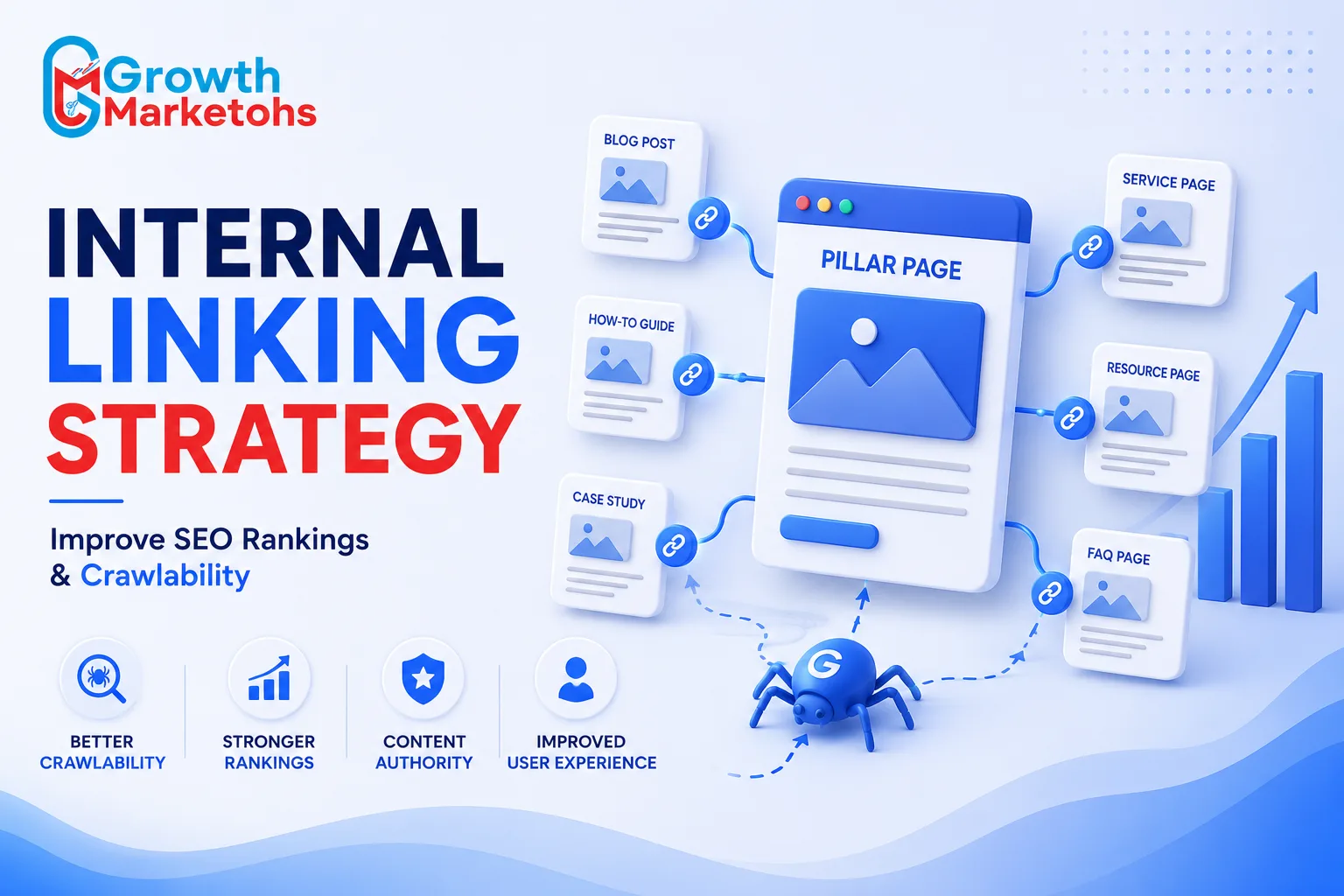
Why do certain pages rank higher without numerous backlinks, while others remain in the depths with quality content? The solution can be found within the site itself, the Internal Linking Strategy. Most companies focus on backlinks and content creation while neglecting one of the most effective SEO tools they already possess: internal links. A weak linking structure results in orphan pages, inefficient crawling, and loss of authority flow.
It is there that an effective internal linking strategy would be vital. A structured SEO strategy for small businesses often depends heavily on internal linking systems to improve rankings and search visibility.
Internal linking not only connects pages; it also guides search engines, spreads authority, helps users navigate, and ensures key pages rank higher.
Properly implemented, an organized internal linking plan enhances the overall web architecture, improves indexing effectiveness, and supports organic growth.
We will break down the steps for creating an effective internal linking strategy in this guide to help us grow SEO long-term.
What is Internal Linking Strategy?
An internal linking strategy is the systematic arrangement of connecting one page of your website to another appropriate page of the same domain. Such links aid search engines in identifying pages, understanding content relationships, and allocating ranking authority to the entire site.
Businesses should first understand how SEO works before implementing advanced internal authority systems. Internal links are under your control, whereas backlinks are provided by other websites.
Having a good internal linking structure provides logical content paths, improves the user experience, and helps content be crawled and indexed faster. More to the point, it helps rank valuable pages with stronger authority cues on your own website.
Importance of Internal Linking Strategy for Better SEO Performance
Most companies invest time in creating content and building backlinks without considering one of the most powerful SEO resources at their disposal: internal links. And that is an expensive mistake. Good internal linking is not simply about linking the pages together but creating a systematic way for search engines and visitors to navigate your site effectively.
Even good content may be buried, lonely, or hard to find without good internal linking. Search engines rely on links to visit pages, understand relationships among subjects, and distribute authority across a site. That is why such a strategy of internal linking is directly integrated to improve rankings, speed up indexing, enhance user experience, and improve overall SEO performance. This also highlights the growing importance of SEO for business in building scalable organic traffic systems.
Improves Crawlability and Page Discovery
Search engines find pages using links. With poor internal linking on your website, critical pages can take longer to locate or fail to be crawled efficiently. An effective internal linking strategy helps search engine bots navigate your site more quickly and explore it more deeply. Improved crawlability will lead to higher rankings and visibility.
A complete technical SEO checklist also helps identify crawl barriers, indexing issues, and weak site structures affecting rankings.
Strengthens Indexing Efficiency
An indexed page cannot rank. Internal links assist search engines in locating new pages more quickly and understanding how they relate to the other material. This enhances indexing speed and makes significant content more effectively incorporated into search results. An adequate internal linking policy minimizes the chances of important pages being ignored by the search engines.
Distributes Page Authority Across the Website
The authority of every page of your site is not equal. Certain pages will automatically achieve greater rankings or backlinks. Internal links are used to distribute that authority to other significant pages and enhance their potential for ranking. With a good internal linking policy, businesses can strategically pass on the SEO value of strong pages to weak pages, enhancing the entire website.
A professional SEO audit service helps identify weak internal authority flow and orphan page issues affecting rankings.
Builds Stronger Topical Relevance
Internal links connect related content and help search engines understand relationships between topics. This enhances the topical authority and improves keyword relevance throughout your site. A strong keyword research strategy helps businesses build better content clusters and semantic relationships between pages.
Internal links help search engines have confidence in your site when they find strong content relationships on that topic. This favors higher positioning in a variety of related keywords.
Improves User Experience and Navigation
Search engines are not the only focus of SEO; users are, too. Internal links allow users to access similar content, navigate your site more easily, and remain more engaged. Enhanced navigation increases session length, bounce rate, and page views. These user signals help in better SEO over time.
Helps Important Pages Rank Faster
The more strategically a business connects to important service pages or high-converting landing pages, the more authority and visibility signals it will have. A clever internal linking strategy helps move key pages higher by strengthening their ties to the authority pages already there. This enhances the ranking speed of high-priority pages.
Reduces Orphan Pages and Weak Content Isolation
Orphan pages are pages that have no internal links. Such pages tend to perform very poorly because search engines struggle to find them, and they do not receive any authority flow. A systematic internal linking plan ensures that all significant pages are interconnected, enhancing the chances of being found and prioritizing opportunities.
Supports Conversion Paths Through Content
Internal links not only enhance SEO but also lead users to take action. An example of this is a blog linking internally to a service page and a service page linking internally to a contact page. This facilitates easier conversion trips.
Businesses looking to improve search visibility and lead generation often work with experienced SEO consultants to build scalable SEO systems. An effective internal linking strategy will facilitate growth in SEO and the business.
Types of Internal Links You Must Understand
It is advisable to learn the various kinds of internal links before developing an internal linking strategy.
It is worth noting that not every internal link is effective before developing a powerful internal linking strategy. Each kind of internal connection has a specific purpose: some enhance navigation, others enhance SEO, and some lead users to conversion. When you treat all internal links as equal, you lose the chance to create a smarter website architecture.
A properly executed internal linking plan incorporates various types of links in combination to enhance crawlability, allocate authority, improve content relevance, and enhance user experience. These are the most relevant types of internal links that every business must know.
1. Contextual Internal Links
Contextual links are links found within the body content of a page. These are the strongest SEO links because they provide strong relevance signals to search engines. Topical connections and the transfer of authority are more successful when a blog is linked to another service page or a blog related to the content. Contextual links are key to a good internal linking strategy, as they enhance rankings and user engagement.
Best use cases:
- Blog to blog linking.
- Blog to service page linkages.
- Relevant content linking.
These are the links that are most valuable for SEO.
2. Navigational Links
Your main menu, header, or site navigation system includes navigational links. The links help users navigate to crucial pages, including services, about, blogs, and contact. As far as SEO is concerned, they indicate page significance because they are present throughout the site. A good internal linking strategy employs navigational links to reinforce important pages and enhance accessibility.
Examples:
- Main menu links
- Top navigation links
- Category navigation links
These enhance usability and page priority.
3. Footer Links
Footer links are located at the bottom of your website and typically link to the crucial supporting pages. They have less contextual SEO value than body-content links, but they are beneficial in enhancing both accessibility and site organization. Footer links will be helpful for linking to the business, policy, and service pages. Footer links are used in a clever internal linking strategy that provides broader access to the entire site without cluttering the main navigation.
Most appropriate pages to place footer links:
- Contact page
- Service pages
- Location pages
- Policy pages
Footer links help in the overall site structure.
4. Sidebar Links
The sidebar links are placed on the side of content pages and are usually used to point out related articles, popular posts, or service pages. They assist users in finding more content in less time and enhance the search process on a page.
Although they are not as powerful as contextual links, they facilitate crawlability and involvement. A balanced internal linking strategy employs sidebar links to enhance content exploration.
Common sidebar uses:
- Related blogs
- Popular articles
- Service highlights
These help increase page views and user flow.
5. Breadcrumb Links
Breadcrumbs indicate page structure and help users know their location on your site. They also introduce hierarchical internal connections among categories and subpages, which enhance crawling efficiency. An effective internal linkage strategy involves breadcrumb navigation that enhances user experience and Web architecture.
Example:
Home → SEO Services → Technical SEO
Benefits:
- Better navigation
- Better hierarchy signals
- Better crawl paths
Breadcrumbs are very helpful for structured websites.
6. Image Links
Image links are clickable images that move users to other internal pages. They are most often used in banners, featured content blocks, and product grids. They will be passed internal authority, but it should never be without proper alt text, so it is optimized to be more relevant to search engines. The image links are used strategically as part of an internal linking strategy to enhance engagement and visibility.
Best uses:
- Featured blog sections
- Service banners
- Product categories
They facilitate navigation and visual interaction.
7. Call-to-Action (CTA) Links
CTA links are action-based internal links, which have been added to direct people into key business pages like contact pages, service pages or landing pages. These links are very essential since they bridge content and conversion potentials. A powerful internal linking plan incorporates CTA links to convert SEO traffic into business action.
Examples:
- Get a Quote
- Contact Us
- Book Consultation
These associations enhance the circulation of lead.
Step-by-Step Internal Linking Strategy to Boost Ranking and Search Visibility
The internal linking strategy does not rely on random page connections or excessive link placement. It follows a hierarchical search engine optimization model that enhances crawling, distributes authority, strengthens topical relevance, and strategically guides consumers through the site.
Proper internal linking helps significant pages rank faster, improves indexing speed, and builds stronger content associations that search engines trust.
When internal linking is done properly, businesses tend to have a stronger search presence and a greater ability to maintain stable rankings, since the webpage’s organization becomes more comprehensible to search engines. The following is an end-to-end internal connecting plan to enhance ranking and search results.
1. Identify Your Most Important Pages First
The first step in an internal linking strategy is to identify the important pages for your business. These are typically service pages, landing pages, product pages, or conversion-oriented pages. These priority pages should have internal links, as they directly influence leads and revenue. Internal linking is random and ineffective without determining your important pages.
Focus on:
- Service pages
- Product pages
- High-converting landing pages
- Local SEO pages
The most internal support should be accorded to your important pages.
2. Build Content Clusters Around Core Topics
Topical authority is employed more by content clusters. Rather than developing single pages, consider clustering similar information around a theme and linking them together. For example, the main page is your SEO Services page, and the supporting pages can include technical SEO, keyword research, on-page SEO, and link building. A systematic internal linking plan connects all these pages to enhance topic relevance. Advantages of content clusters:
- Better content organization
- Stronger authority signals
- Improved keyword coverage
- Better crawl paths
Clusters make it easier for search engines to understand your expertise. Modern SEO systems also rely on semantic clustering and AI-focused optimization strategies to strengthen topical authority.
3. Use Contextual Links Inside Content Naturally
Contextual internal links are the best links in SEO, as they offer relevance and authority within the real content. Each blog post, service page, or landing page must include internal links to related pages. These links help search engines understand page relationships and enhance user navigation. Contextual links are essential to a powerful internal linking strategy because they offer greater SEO value.
Best practices:
- Aligned in paragraphs.
- Keep links relevant
- Avoid forcing links
4. Create Strong Anchor Text Relevance
Anchor text informs search engines about what the linked page is about. Weak anchors decrease relevance signals, and strong descriptive anchors enhance topical knowledge. A smart internal linking approach will use understandable, natural anchor text relevant to the subject without over-optimization.
Advanced on-page optimization and structured linking systems are essential components of modern on-page SEO.
Examples of good anchor text:
- technical SEO services
- keyword research strategy
- local SEO expert
Use non-generic anchors, such as “click here,” whenever possible.
5. Link from High-Authority Pages to Important Pages
Certain pages inherently have more authority due to ranking higher, having more backlinks, or receiving more traffic. Internal links can transfer more SEO value to crucial pages on these pages. A powerful internal linking policy involves using authority pages strategically to boost less powerful yet significant pages.
The pages with high authority tend to have:
- Homepage
- Popular blogs
- Top-ranking service pages
This enhances ranking faster.
6. Repair Orphan Pages and weak content relationships
Orphan pages are pages without internal links. Such pages usually lose out because they are crawled and ranked by search engines less often. All internal linking plans must include creating orphan pages and linking them to related content. This enhances search and content integration.
What to fix:
- Unlinked blogs
- Forgotten landing pages
- Loosely linked service pages.
No significant page ought to remain isolated.
7. Build Logical Site Architecture
User experience and SEO are influenced by the website’s structure. An effective site hierarchy simplifies search engines’ process of recognizing the relationship between content and page significance. There should be a systematic internal linking strategy that supports a clean site architecture, with pages well linked from broad subject pages to detailed pages.
Ideal structure:
- Homepage
- Category pages
- Service pages
- Supporting blogs
High hierarchy enhances the efficiency and relevance of crawling. Businesses facing crawlability and indexing issues often benefit from advanced technical SEO services focused on site architecture optimization.
8. Update Old Content with New Internal Links
Older content usually has authority and rank. Modifying existing blogs or pages to include links to new information helps pass on authority and enhance page discovery. A shrewd internal linking plan relies on existing strong material to promote new or weaker pages. With the right content marketing services, you can move towards optimizing content for better rankings.
Benefits:
- Faster indexing
- Better authority flow
- Improved content freshness
Strategic updates add value to the old content.
9. Add Internal Links for Conversion Paths
Internal linking is considered not only for SEO but also for business growth. The blogs are supposed to direct the users to the service pages, and the service pages are supposed to direct the users to the contact or inquiry pages. An effective internal linking strategy enhances the customer journey by taking customers nearer to action.
Examples:
- Blog → Service page
- Service page to Contact page.
- Case study → Consultation page.
This enhances conversion opportunities.
10. Audit and Improve Internal Links Regularly
Internal linking is not a unitary affair. New linking opportunities emerge as the amount of content expands. Businesses ought to perform routine audits of their internal links to identify broken links, poor anchors, orphan pages, and opportunities missed. Healthy internal linking plan develops as your site grows.
Regular audit areas:
- Broken links
- Missing internal links
- Orphan pages
- Weak anchor text
- Overlinked pages
The structure is maintained by continuous improvement.
Common Internal Linking Mistakes to Avoid
A good internal linking strategy can go a long way in enhancing rankings, crawlability, and search visibility; however, only when done right. The issue is that most businesses include internal links without organization, intent, or a plan.
Rather than enhancing SEO, poor internal linking often confuses search engines, reduces the flow of authority, and harms the user experience. Internal linking is not a matter of quantity but rather a matter of relevancy, hierarchy and strategic page links.
These are the most frequent errors that can be avoided to make your internal linking strategy much more useful and allow your significant pages to rank more quickly.
1. Linking Pages Without Relevance
Among the greatest errors in businesses is a correlation between pages that have no topical relation. Search engines should understand relationships among content through internal links.
Linking unrelated pages undermines contextual cues and disorients both users and search engines. A powerful internal linking strategy is one that emphasizes relevance. All internal connections must be logical in content and flow the user experience in a natural way.
2. Overloading Pages with Too Many Internal Links
The more links, the better SEO. When too many internal links are included on a page, their value is diluted, making it difficult for search engines to determine which links are most important.
It also fills users. A smart internal linking strategy is quality-oriented rather than quantity-driven, making internal links strategic, relevant, and focused rather than excessive.
3. Ignoring Important Pages
Most businesses often link internally to blogs but do not support their primary service pages, product pages, or landing pages. This is one big missed opportunity. Significant pages require a local authority to be ranked higher.
High-value business pages must always be prioritized in a proper internal linking strategy, since these pages drive business leads and conversions.
Pages often ignored:
- Service pages
- Product pages
- Location pages
- Contact pages
These are to be supported more internally.
4. Using Weak or Generic Anchor Text
Anchor text informs the search engine of what is on the linked page. Bland expressions such as “click here” or “learn more” kill SEO chances since they provide no clues of relevance. An effective internal linking strategy involves descriptive anchor text that clearly represents the topic of the linked page. Enhanced anchor text enhances context, relevance, and ranking indicators.
Weak examples:
- Click here
- Read more
- Visit page
Stronger examples:
- technical SEO checklist
- keyword research strategy
- internal linking strategy
5. Leaving Orphan Pages Unlinked
Orphan pages have no internal links. These pages tend to have crawlability, indexing and ranking issues since search engines have fewer avenues of locating them. An organized internal linking plan ensures that all significant pages are interconnected within the site’s content ecosystem. None of the valuable content should be left alone.
6. Not Updating Old Content with New Links
Older content tends to have authority and rankings, and the business seldom updates it to accommodate new pages. This is an opportunity that has been lost. A clever internal linking strategy employs old content to empower new blogs, service pages or landing pages by conveying authority and enhancing discoverability. Active internal linking should include old content.
7. Broken Internal Links
Bad internal links result in a poor user experience and a waste of crawl budget. They cut into user paths and minimize trust indicators. Broken links can also pose a problem because search engines may be unable to comprehend your site. A good internal linking strategy includes frequent audits to detect and rectify dead links before they affect search engine results.
Conclusion
One of the strongest yet least-known SEO systems for achieving long-term search growth is a strong internal linking strategy. It enhances crawling and indexing, distributes authority, and helps significant pages rank faster without relying solely on backlinks. Internal linking strategy can make your site an integrated SEO ecosystem when designed correctly: each page helps drive visibility, traffic, and conversions.
To stay ahead of the SEO game with the best Internal Linking strategy, Growth Marketohs is the best SEO agency to boost your business growth. At Growth Marketohs, we have a team of SEO experts with hands-on experience in game-changing interlinking strategies that have boosted brands’ rankings.
Want to achieve more competitive search visibility, quicker page positioning, and a more user-friendly experience that will propel your business higher and higher?
Contact us today, and our team of SEO and digital marketing experts will understand your requirements and develop the best strategy your website needs to grow smarter and rank higher.
If your business wants stronger rankings, improved crawlability, and scalable SEO growth, work with a trusted SEO Agency for business growth.
FAQs
Internal linking strategy refers to the process of linking pages on your site to enhance crawlability, the distribution of authority, user navigation, and overall performance in search engines, helping you rank higher.
Internal linking helps search engines find pages, understand relationships between content, allocate ranking power, improve the indexing process, and reinforce essential pages to enhance search presence.
There is no exact amount, but internal links must be relevant, natural, and helpful to users, but they must also serve the purpose of SEO without making the page too bulky.
Yes, a powerful internal linking strategy enhances the flow of authority, topical relevance, search engine crawling, and the faster ranking of important pages.
Yes, Growth Marketohs develops systematic internal linking plans that enhance crawlability, authority flow, rankings, and long-term SEO performance for businesses.