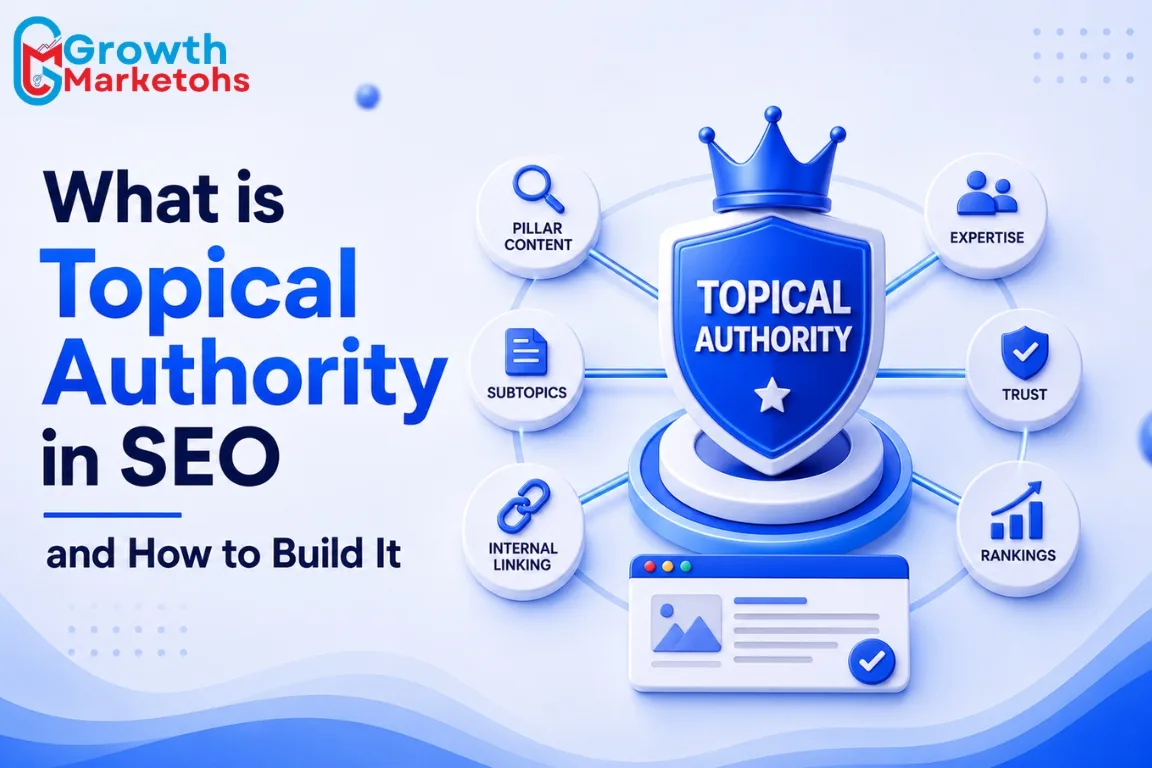
Topical authority SEO is the process of establishing your website as a trusted source on a specific subject by creating comprehensive, interconnected, and experience-driven content around that topic. By covering related subtopics, strengthening internal links, demonstrating expertise, and satisfying multiple search intents, businesses can improve rankings, increase organic visibility, and gain stronger exposure in Google Search, AI Overviews, and AI-powered search experiences.
Why do certain websites appear in the search results of hundreds of keywords, and others cannot even be ranked after updating their blogs regularly? Topical Authority SEO is the solution. Today’s search engines do not rank websites based on isolated keywords or backlinks.
Their top priorities are websites that demonstrate extensive knowledge, provide comprehensive coverage of the topic, and maintain reliable content ecosystems. It is precisely there that topical authority seo will be one of the most effective SEO growth strategies in 2026.
Nowadays, Google and other AI-based search engines want to know whether your website is actually knowledgeable about a particular topic.
What is Topical Authority in SEO?
The topical authority seo involves developing profound knowledge and credibility in a particular subject through the development of highly interconnected and related content that is extremely relevant. Topical authority revolves around writing in-depth content on a single niche rather than making random blogs on unrelated topics, using content clusters, internal linking, and semantic and search-intent optimization.
A strong SEO strategy for small businesses often begins with building topical authority around a focused subject area rather than targeting disconnected keywords.
Today, topical authority SEO is no longer important only for traditional Google rankings. AI-powered search systems such as Google AI Overviews, AI Mode, ChatGPT Search, Gemini, and Perplexity increasingly rely on authoritative sources when generating answers. Businesses preparing for AI-powered search should also understand how AI SEO is changing content visibility and search rankings.
Websites with stronger topical authority are more likely to be referenced, cited, and surfaced in these AI-driven search experiences.
For example, a website that publishes only one blog post about SEO has weak authority.
But a website covering:
- Technical SEO
- Keyword research
- Link building
- Internal linking
- Local SEO
- AI SEO
- SEO audits
Search engines also evaluate entities such as brands, businesses, authors, and organizations. Building topical authority SEO around a specific subject strengthens entity recognition and helps search engines associate your brand with expertise in that topic area. This connection is becoming increasingly important as AI search systems continue to evolve.
Importance of Topical Authority in SEO
Contemporary SEO is no longer about ranking a particular keyword on a single page. Search engines have begun to place greater emphasis on websites that consistently publish high-quality, relevant, experience-based information on a single subject. This is the reason why topical authority seo has become a necessity to the businesses that desire to have long-term search results and better rankings.
1. Improves Rankings Across Multiple Keywords
Topically relevant websites that have high topical authority seo tend to be ranked in hundreds of related keywords since search engines have confidence in their knowledge within the entire topic system and not only on the individual pages. This is one reason why businesses investing in professional SEO services often achieve more sustainable ranking growth than websites relying on isolated content efforts.
2. Builds Stronger Search Engine Trust
Search engines favor websites that have proven experience and credible information. Powerful topical authority cues enable Google to have greater confidence in your site than in your competitors with fragmented or anorexic content approaches.
3. Supports Better AI Search Visibility
AI-generated search experiences increasingly prioritize authoritative websites. Businesses with strong topical authority SEO are more likely to appear in Google AI Overviews, AI Mode responses, featured snippets, and AI-generated answers across modern search platforms. As AI search becomes more common, topical authority helps increase visibility beyond traditional organic rankings.
4. Strengthens Internal Linking Structure
The subject matter content has a natural tendency of forming internal linking opportunities. This enhances crawlability, authority distribution, and page relationships within your site.
5. Improves User Experience and Engagement
Whenever users get all the coverage of topics on your site, they spend more time, visit more pages, and believe in your expertise. These signs of engagement enhance SEO.
6. Creates Long-Term SEO Stability
High topical authority seo websites tend to keep their positions higher during algorithm changes since their authority is obtained through expertise, trust, and content richness instead of shortcuts.
How do Search Engines Prioritize Sites With Topical Authority SEO?
The mission of Google has been to provide the most relevant, credible, and experience-based responses to the user. In recent years, search rankings have moved away from the use of keyword stuffing and skeleton content to expertise, semantic relevance, and content quality based on the updates performed on the algorithm. This development saw topical authority seo emerge as one of the most powerful ranking systems in contemporary search.
Panda Update Focused on Content Quality
The panda update by Google was against low-value websites with repetitive, thin, or useless content. This moved companies towards making more original and useful topic-specific content.
Hummingbird Introduced Semantic Search
The update to Hummingbird altered the way Google interpreted queries. Instead of seeking exact matches only, Google began to comprehend meaning and context, and topical relevance became much more important. Understanding how SEO works helps businesses adapt to Google’s transition from keyword matching to semantic understanding.
E-E-A-T Strengthened Expertise Signals
Google has extended E-A-T to E-E-A-T by incorporating Experience, which puts a premium on firsthand experience, authority, and credibility. Sites that exhibited actual subject-matter expertise received greater ranking benefits.
Helpful Content Updates Rewarded Useful Content
The latest Helpful Content announcements placed a strong emphasis on rewarding useful, human-first content and on de-emphasizing thin, AI-spammed, or low-value pages made solely to manipulate traffic.
Core Ranking Systems Now Evaluate Helpfulness Continuously
The modern ranking systems at Google keep analyzing all the helpfulness, topical depth, relevance, and trust signals of the content. Websites that have better topical authority seo now have wider visibility benefits.
AI Mode and AI Search Are Increasing the Importance of Topical Authority
Google’s AI Mode can break complex search queries into multiple related questions and evaluate content across an entire topic rather than relying on individual pages alone. This means websites with strong topical coverage, interconnected content clusters, semantic relevance, and demonstrated expertise often have a greater opportunity to appear in AI-generated search experiences. As search becomes more conversational, topical authority becomes an even stronger competitive advantage.
AI Search Prioritizes Trusted Topic Experts
The use of AI in search experiences depends on the trusted sources. The websites that have better topic ecosystems, semantic relationships, and expertise signals have higher chances of showing up in AI-generated responses.
Topical Authority SEO vs Traditional SEO
| Factor | Topical Authority SEO | Traditional SEO |
| Focus | Complete topic coverage | Individual keywords |
| Content Style | Topic clusters | Isolated pages |
| Internal Linking | Strongly connected | Limited linking |
| Search Intent | Multiple intent layers | Single keyword targeting |
| Authority Building | Expertise-focused | Ranking-focused |
| SEO Growth | Long-term scalable | Short-term keyword wins |
11 Ways to Build Topical Authority SEO
The process of producing topical authority seo is more than just regular blogging. It requires organization, regularity, semantic topicality, and substance. Companies that develop high topical authority establish comprehensive search ecosystems to enhance rankings, trust, and visibility across a broader set of keywords.
1. Choose One Clear Topic Niche
Topical authority builds more quickly when your site focuses on a niche rather than haphazardly covering unrelated topics. Search engines have more faith in specialization than in scattered content. A narrow niche establishes stronger semantic ties and better indications of expertise
2. Build Topic Clusters Around Core Pages
Topic clusters are the backbone of topical authority seo. Create one main pillar page and support it with related subtopics linked internally. A well-planned internal linking strategy helps strengthen relationships between topic clusters and pillar pages.
Example:
- SEO Services
- Technical SEO
- Link Building
- Keyword Research
- Local SEO
This structure strengthens topical relevance and crawlability.
3. Create Deep, High-Value Content
Thin content weakens authority. Search engines reward websites that answer topics comprehensively and demonstrate real expertise.
Strong content should include:
- Detailed explanations
- Real-world examples
- Industry experience
- Original insights
- Practical recommendations
- User intent coverage
- Expert opinions
- Case studies
- Updated information
Google’s recent updates increasingly reward experience-driven content rather than generic information available everywhere online. Content that demonstrates real expertise and practical implementation often performs better in both traditional search and AI-powered search experiences.
4. Use Semantic SEO and Related Keywords
Contemporary search engines understand context and the interrelations among words. A strong keyword research strategy helps identify semantic opportunities and related search intent that support topical authority.
Rather than overusing a single keyword, add semantically related phrases and supporting ideas naturally. This enhances superficial knowledge and broadens keyword coverage.
5. Strengthen Internal Linking Structure
Internal linking connects your content ecosystem together. It helps search engines understand relationships between pages while strategically distributing authority. Professional content marketing services help businesses develop structured topic clusters that improve authority and organic visibility.
Best practices:
- Link related blogs naturally
- Connect cluster pages to pillar pages
- Use descriptive anchor text
6. Cover Multiple Search Intents
Users search differently depending on their stage in the journey. Strong topical authority requires covering:
- Informational intent
- Commercial intent
- Transactional intent
7. Publish Consistently Around the Same Topic
Consistency signals expertise. Websites that post consistently within a single niche gain authority more quickly than those that post sporadic, unrelated content.
8. Build Topically Relevant Backlinks
Topical trust is reinforced by relevant backlinks. Modern link building strategies focus on earning relevant authority signals rather than acquiring large volumes of low-quality links.
Backlinks are considered more useful by search engines when they come from a website related to or belonging to a specific industry.
9. Refresh Old Content Regularly
Power is undermined as content becomes obsolete. The continuous renewal of statistics, examples, internal links, and search intent is essential for keeping your content fresh and competitive.
10. Build Author and Brand Trust Signals
Search engines also consider brand credibility, author expertise, and user trust. Good branding aids in long-term topical authority seo. Businesses working with an experienced SEO expert in India often build stronger trust signals, authority, and long-term search visibility.
11. Build Topic-Specific Case Studies
Case studies help strengthen expertise and trust signals. Businesses that publish real-world examples, campaign results, implementation processes, and measurable outcomes often build greater authority than competitors that rely only on educational content. Case studies also support E-E-A-T by demonstrating practical experience within a topic.
Top Ways to Measure Topical Authority SEO
Topical authority measurement seo assists companies in their awareness of how well their site displays knowledge and depth of the subject. Visibility, keyword growth, internal content strength, and engagement indicators can be used to measure authority.
1. Keyword Visibility Growth
When your site begins to rank in terms of higher-level related keywords, it is an indicator of the higher level of topical authorship development in your niche.
2. Organic Traffic Expansion
An increase in organic traffic across related subjects indicates that search engines are placing more trust in your content ecosystem.
3. Internal Linking Strength
A well-established topic ecosystem tends to have clear content clusters and well-structured internal linking relationships, providing crawlability and authority flow.
4. Search Console Performance Data
To determine which topic should be expanded, Google Search Console assists in the point of identifying related keywords, impressions, clicks, and prioritizing growth in related content.
5. Backlink Relevance
Topical trust is enhanced with topical backlinks on industry-related web pages, which enhance authority signals around your intended niche.
Best Content Structure for Topical Authority SEO
Good content structure helps search engines effectively understand relationships between topics. Structured content ecosystems are essential for scalable topical authority seo growth.
1. Pillar Pages
Pillar pages serve as the main authority pages for a broad topic and link to supporting cluster content. A well-structured website architecture, created through professional website design and development services, can support better content organization and crawlability.
2. Cluster Content
Supporting blogs cover detailed subtopics related to the pillar page via internal linking.
3. Contextual Internal Links
Internal links strengthen relationships between topics and help search engines understand the content hierarchy and the distribution of authority.
4. Semantic Keyword Optimization
Using related terms and supporting concepts naturally strengthens topical relevance without keyword stuffing.
5. Content Depth and User Intent
Every page should fully satisfy user intent with clear structure, examples, insights, and actionable information.
Conclusion
In the year 2026, there will be no more ranking of isolated pages or keyword-cramming in blogs. Search engines now place value on expertise, trust, semantic relevance, and entire topic ecosystems. That is why topical authority seo is now one of the best long-term SEO growth strategies that businesses that are serious about being on top of search visibility have adopted. The acquisition of topical authority by brands makes them rank higher, improves the AI search experience, and drives more organic traffic. This is where Growth Marketohs comes into play.
Growth Marketohs is the best SEO company that structures content ecosystems, plans semantic SEO, and implements authority-based digital marketing that enables businesses to build long-term topical authority that translates into rankings, visibility, leads, and revenue gains. We provide professional SEO and digital marketing services to gain real digital authority and dominate search results.
Whether your goal is SEO growth, content authority, website performance, or digital visibility, Growth Marketohs helps businesses build sustainable online authority through integrated digital marketing strategies.
FAQs
The topical authority SEO concept involves accumulating deep knowledge and credibility on a particular topic by establishing a content ecosystem of connected, high-quality, and extensive content that helps search engines perceive your site as an expert in that niche.
Topical authority helps websites rank across a wider range of keyword sets, enhancing search engine credibility, AI search relevance, and long-term ranking stability by demonstrating experience, pertinence, and utility within a broader topic ecosystem.
The topical authority SEO process typically takes several months, depending on the competition, content quality, internal link structure, backlink quality, and the level of regular coverage of the topic on the site.
Topical authority can be developed in the most effective manner with the use of topic clusters, semantic SEO, regular publishing, good internal links, search intent optimization, and the development of high-value content (detailed and focused around one niche).
Yes, websites with high topical authority are more likely to appear in AI-generated search results because AI systems prioritize reliable, in-depth, experience-based information from reputable, topic-specific websites.