Rather than merely matching keywords, Claude AI sources are preferred based on their relevance, context, user intent, authority, and content quality. Claude assesses the accuracy, trustworthiness, and completeness of content to meet a user’s query.
The higher the degree of authority, relevance to the query, and experience and expertise of a website, the greater the odds that the website will be cited by AI-generated responses. With the fast-growing reliance on AI tools like Claude, ChatGPT, Gemini, Perplexity, and Google AI Overviews, understanding how Claude selects information is vital for businesses.
As search continues to evolve, authoritative user-centric information that meets expectations of modern AI-driven search can lead to greater visibility, citations, authority signals, and better opportunities to be found in AI-powered search experiences.
What Are Claude AI Sources?
Claude AI answers questions by examining the content available and the information most relevant to them. Claude AI sources are the information, references, websites, documents, and knowledge that can be used to support the AI-generated responses.
Unlike traditional search engines that present a list of webpages, Claude focuses on generating direct answers. Evaluating the source is therefore even more critical when building a response to a text, as the system should determine which information is credible, pertinent, and useful.
What Claude Considers a Source
A source is anything that might provide a helpful answer to a question, including information from a credible source. It can take the form of websites, articles, research papers, documentation, industry resources, and authoritative information that provides proper context for a topic.
Why Sources Matter in AI Responses
Sources enable AI systems to provide more accurate, balanced, and trustworthy answers. Strong sources enhance response quality and reduce misinformation and incomplete information.
How Claude Differs From Traditional Search Engines
Traditional search engines rank webpages and allow users to choose which results to view. Claude is trained to summarize and provide a direct response. This involves more scrutiny of the quality and relevance of the sources.
Claude’s Focus on Trust and Context
Claude focuses on context and understanding over just keyword matching. The whole idea behind this system is to recognize information that truly answers user questions and that is accurate and useful.
Sources vs Citations in AI Systems
The AI relies on sources to provide information, and citations indicate where that information comes from. In the era of evolving AI search, transparency in citations is gaining significance.
Why Businesses Should Care About Claude SEO Services and Claude AI Sources
Companies that understand how AI systems evaluate sources can develop more robust content strategies. This makes it easier for people to see and provides more opportunities for brand mention and citation.
How Claude AI Selects Sources
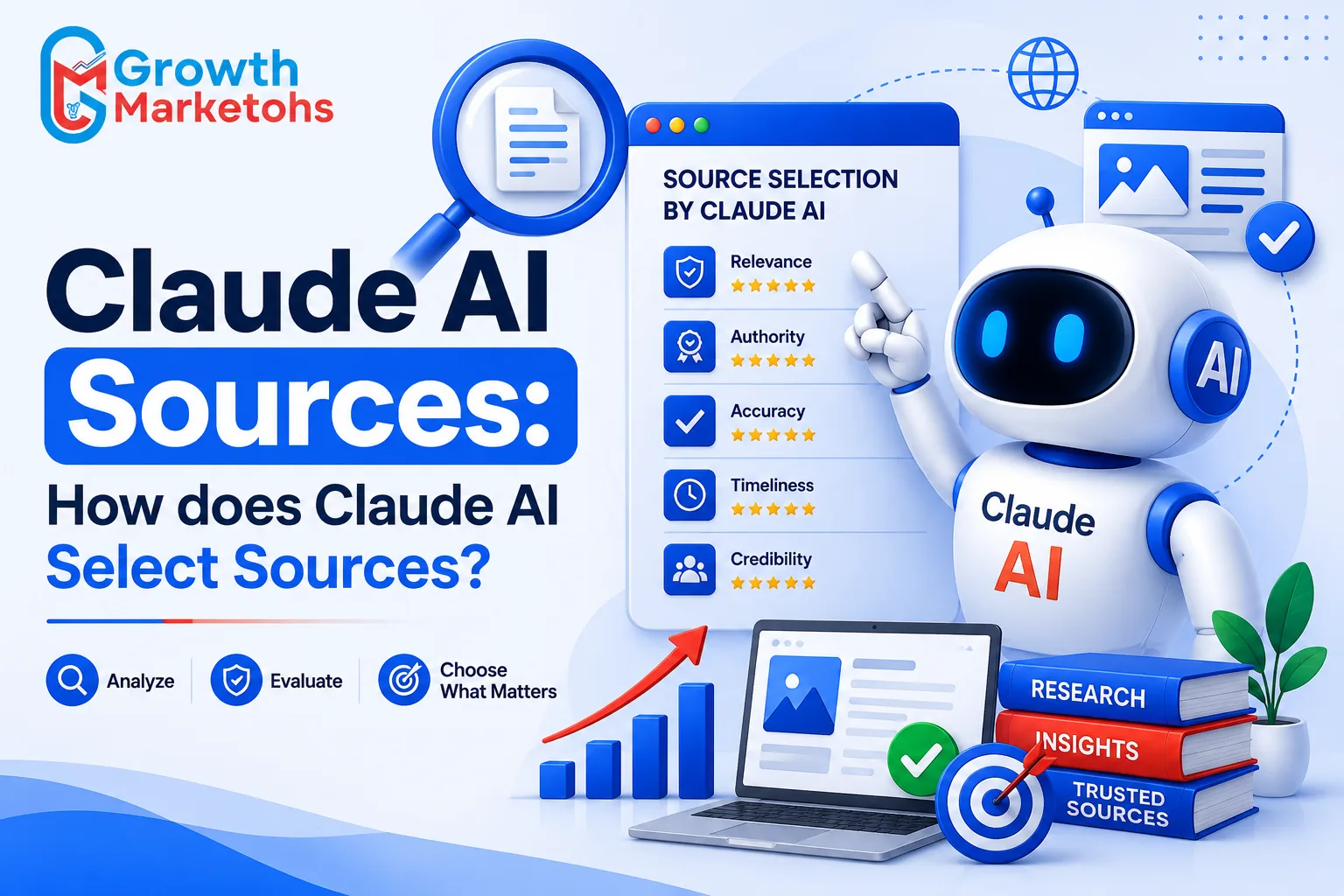
To enhance AI search visibility, businesses must understand how Claude AI sources work and how Claude SEO Services help improve discoverability. Claude isn’t just searching for pages that have the same keywords. Instead, it will analyze several signals to assess the content’s trustworthiness, relevance, thoroughness, and usefulness for the user’s needs.
In modern AI systems, it’s not about presenting a list of webpages but about providing the most relevant answer, which makes the process of choosing sources much more complex.
1. User Intent Comes First
For Claude AI sources, the first piece of context to consider is user intent. The system tries to determine how it will be used before selecting information.
For instance, a search’s purpose could be
- Informational intent
- Commercial research
- Product comparison
- Educational learning
- Industry research
- Problem solving
When someone asks for the “best SEO strategy for AI search,” Claude looks for content specifically geared towards that topic instead of keywords. Highly relevant content is more likely to be included in AI responses compared to content that doesn’t align with the searcher’s intent.
2. Contextual Relevance Evaluation
Claude pays special attention to context, not just to individual words. It assesses the overall relevance of the material and its contributions to the query’s content.
For instance, an article on AI SEO, entity SEO, topical authority, and AI-optimized search engines can be more relevant than a site that repeats the same keyword over and over again. With this contextual knowledge, Claude can provide more comprehensive and relevant answers.
3. Authority and Trust Signals
One of the key decision factors in choosing a source is trust. Claude will trust content that demonstrates expertise, credibility, and reliability.
Authoritative language cues are:
- Expert-written content
- Industry experience
- Demonstrated expertise
- Established brand reputation
- Consistent publishing history
- High-quality information
Frequently, websites that can produce trustworthy content perform better in the rankings for AI solutions.
4. Topical Authority Assessment
Claude determines whether a web page has a global level of expertise on a topic instead of a specific article. This is called topical authority, one of the strongest signals search engines and AI systems use to evaluate expertise.
For instance, a web page that posts data about:
- Technical SEO
- Link building
- Internal linking
- AI SEO
- Entity SEO
- SEO audits
A site with just one SEO article will seem less impressive compared to one with more. Having good topical authority gives AI systems confidence that a site has extensive expertise on a topic.
5. Freshness and Accuracy Signals
The information is too dynamic across SEO, AI, technology, and digital marketing. Claude seeks content that reflects current information and recent developments whenever freshness is important to the query.
Top content gets better when it’s updated, and it offers:
- Current trends
- Updated strategies
- Recent examples
- Relevant industry changes
- Accurate recommendations
Frequently updated content improves the odds that a website will be seen as a valuable source of claude AI.
6. Content Completeness
Claude likes extensive content that answers a question comprehensively, rather than partially. The pages that add explanations, examples to prove and explain, concepts and related ideas, and any practical advice have tended to do better.
Typically, thorough content would contain the following:
- Clear definitions
- Step-by-step guidance
- Supporting examples
- Related questions
- Practical applications
- Expert insights
7. Entity Relationships
Today’s AI systems have a growing capacity to recognize entities like brands, businesses, authors, organizations, products, and services. Claude provides insights into the relationships between these entities and the selected topics and industries.
Ensure that you accompany your entity signals with strong ones, such as:
- Consistent brand mentions
- Author expertise
- Industry recognition
- Topic specialization
- Content relevance
Businesses investing in Claude SEO Services Company are increasingly focused on entity optimization and topical authority.
8. Semantic Relevance
The semantic relevance is a feature that allows Claude to grasp relations between concepts. It can determine not only the keywords that are matched exactly but also the reference topics, supporting ideas, and contextual clues.
For instance, businesses investing in AI SEO Services often create content covering the following sections:
- AI search optimization
- Google AI Overviews
- Entity SEO
- Topical authority
- Semantic SEO
- Content clusters
Such integrations aid Claude in understanding the depth and expertise of the topics, increasing the likelihood that it will provide AI-generated answers.
Why Claude AI Prefers Some Websites Over Others
Not all websites will have an equal probability of being included in Claude AI sources. AI systems are developed to prioritize information that demonstrates expertise, relevance, trustworthiness, and depth of topic. Though keywords are important, today’s AI systems consider a broader range of indicators to determine which content to prioritize. These elements can be crucial for developing content that will be cited in AI-powered search results.
1. Strong Topical Authority
Regularly creating content on a niche or narrow topic can create greater topical authority. Claude will be more likely to trust a website that covers a whole ecosystem of topics rather than one that just has articles.
For instance, a web page that talks about the following:
- Semantic SEO
- Topic Clusters
- Entity SEO
- AI SEO
- Technical SEO
- SEO Audits
A website with one article on SEO shows a less in-depth understanding than a website that demonstrates this expertise. High topical authority indicates depth of content and experience over the long term.
2. Better Entity Recognition
Entities are key to AI systems’ understanding of authority and expertise. Patterning or association regularly becomes stronger with brands, authors, organizations, and businesses that are always related to specific topics.
The following are good entity signals:
- Consistent brand mentions
- Industry recognition
- Expert author profiles
- Topic specialization
- Thought leadership content
The greater the entity association, the easier it is for Claude to relate expertise to a specific topic area.
3. Experience-Driven Content
Real-world experience is becoming an increasingly important factor in modern search and AI systems. Content that shows practical knowledge has performed better than content created solely for targeting keywords.
Examples include:
- Case studies
- Industry insights
- Original research
- Practical examples
- Implementation experiences
Credibility is built with experience and the greater usefulness of content.
4. Comprehensive Topic Coverage
Claude wants content that goes into depth about a subject. Sometimes, information that resolves a number of related queries and provides context is more useful than shallow information.
Typically, comprehensive content contains:
- Definitions
- Benefits
- Examples
- Best practices
- Common mistakes
- FAQs
This depth leads to a better user experience and improved AI comprehension.
5. Consistent Publishing and Content Freshness
Websites that are frequently updated and continually extended will provide more accurate information. When answering time-sensitive questions, Claude might give preference to information that aligns with recent industry trends, technologies and developments.
Consistent publishing demonstrates:
- Ongoing expertise
- Active industry involvement
- Content maintenance
- Relevance to current topics
- Fresh content helps maintain authority over time
6. Strong Trust and Quality Signals
One of the fundamental aspects affecting source selection is trust. Claude AI will be more valuable on websites that show trustworthiness, accuracy, transparency, and expertise.
Some characteristics of trust signals may include:
- Well-structured content
- Expert authorship
- Accurate information
- Clear sourcing
- Strong website reputation
As AI search evolves, sites with authority, expertise, topical depth, and user value will gain greater visibility, citations, and recognition in the AI-powered search landscape.
Claude AI Sources vs Google Search Results
Although both Claude AI and Google aim to provide users with helpful information, they approach information retrieval differently. Traditional search engines are used to rank a web page, and AI systems are used to produce answers. This distinction leads to a different approach to content evaluation and surface.
| Factor | Claude AI | Google Search |
| Primary Goal | Generate direct answers | Rank webpages |
| Focus | Context and relevance | Ranking signals |
| Information Sources | Multiple sources combined | Individual pages |
| User Intent Analysis | Very high priority | High priority |
| Topical Authority | Strong influence | Strong influence |
| Entity Understanding | Critical factor | Important factor |
| Content Synthesis | Yes | No |
| Citations and References | Increasing importance | Established practice |
Both systems recognize quality content that is authoritative, topical, user focused and shows expertise. Companies that strive to be trusted, relevant, and all-encompassing in their content will be more successful in both the regular search engine and the AI-driven search engine arena.
How to Optimize Content for Claude AI Sources
With the advent of AI-driven search, businesses need to employ content strategies that align with how content is sourced. It’s not about optimizing algorithms; it’s about creating content that demonstrates expertise, authority, and usefulness. Having a website with consistent, valuable content over the whole topic can increase the visibility of your website in the answers generated by AI.
The goal of the optimization scheme is to minimize the following:
Build Strong Topic Clusters
Develop multiple article topics that tie together as a whole, rather than publishing individual articles. Topic Clusters SEO boosts topical authority and improves how AI systems understand expertise across a subject.
Demonstrate First-Hand Experience
Provide relevant examples, case studies, practical advice, and real-life applications with credible expertise.
Create Comprehensive Content
Answer questions in relation to the keyword, but explain the concepts that support it and give background information.
Strengthen Entity SEO
Develop high-quality connections among your brand, authors, services, and industry topics to improve entity recognition.
Implement a strategic Internal Linking Strategy
Make strategic connections to content to enable AI systems to better comprehend the relationships and structure among topics.
Publish Helpful, User-Focused Information
Do not produce content for ranking purposes only, but rather to provide a solution to problems and meet the users’ intent.
Maintain Content Freshness
Keep articles up-to-date with industry changes, new trends and new developments.
Strengthen E-E-A-T Signals
Prove experience, expertise, authoritativeness, and trustworthiness across your content.
By using these principles consistently, businesses are more likely to make an impact on Claude, Google AI Overviews, ChatGPT Search, Gemini, and future AI-driven search experiences.
Common Reasons Claude AI Ignores Content
Many companies think they can simply publish content and they will be discovered by AI-powered search engines. But not everything is worth being included in valuable Claude AI sources. The goal of Claude is to deliver accurate, relevant and trustworthy information, thus minimizing the chance of referencing content that is lacking in quality, authority, or context. By knowing about these prevalent issues, businesses can optimize their content strategy and enhance the visibility of their AI search results.
1. Thin Content With Limited Value
Content that does not provide in-depth information may not be noticed. Articles that don’t provide examples, explanations, or useful advice may not be sufficiently informative for an AI to be confident in citing them.
2. Weak Topical Authority
It takes one article to become an expert. A website with only a single post or article doesn’t look as authoritative as a business with a broader content ecosystem of topic clusters.
3. Poor Search Intent Alignment
If the content does not answer the question, it’s not useful. Claude emphasizes information that most closely matches user needs and addresses their problem well.
4. Lack of Context and Semantic Relevance
AI can struggle to grasp content that only covers the exact text-wording keywords without touching on related concepts. Claude’s focus is on content that covers topics broadly and is contextually relevant.
5. Outdated Information
AI systems are looking for trustworthy, up-to-date data. Outdated strategies, statistics or recommendations may become less reliable in the articles over time, especially in the dynamic areas of SEO, AI, and technology.
6. Weak Entity and Trust Signals
If a website lacks expertise, author information, brand recognition, or industry authority, it could dampen trust. Claude can identify an entity signal and gain insight into its ownership and purpose for including the content.
7. Poor Content Structure
When a website’s content is not organized, it can be difficult for users and AI systems to grasp the information. Information is more accessible and relevant when there are clear headings, logical flow, supporting examples and well-structured information.
8. Lack of Original Insights
It is important not to be duplicative in content, thereby providing no unique value. The fresh thinking, experience, case studies, and expert knowledge that Claude is exposed to often improve answer quality.
By prioritizing authority, expertise, relevance, and user value, companies are likely to secure a more prominent position in the broader AI search landscape and become trusted Claude AI sources for AI-powered search.
How to Measure AI Search Visibility
The more businesses turn to AI for search optimization, the more vital it is to measure its performance. AI-powered search offers new visibility opportunities that should be monitored alongside traditional SEO metrics such as rankings and traffic. These indicators provide insights into the distribution of a business’s content and what search engine platforms see, as well as how this affects AI Overviews or conversational search experiences.
AI Citations and References
One of the main ways to assess AI visibility is to check whether your content, brand, or website appears in AI-generated answers. Citations may relate to citation authority and relevance.
Brand Mentions Across Search Ecosystems
Track your brand’s search engine presence, presence in industry conversations and presence in AI-generated outputs. Broader AI visibility can be facilitated by strong brand recognition.
Google AI Overview Presence
Monitor whether your content is present in AI-generated summaries. Content that appears in the AI Overviews suggests it is relevant and authoritative to search systems.
Organic Traffic Growth
With higher organic traffic, you are likely establishing stronger topic authority and search visibility. It continues to be considered one of the most valuable metrics for content performance.
Topic Authority Expansion
Track the number of related keywords and topic variations your content ranks for. A better topical authority often includes using broader keywords.
Engagement Metrics
All of these metrics show whether visitors are benefiting from your content and include pages per session, return visits, engagement rate, time on page, etc.
Entity Recognition Growth
With the rise in entity SEO, companies need to track progress towards their brand searches, author prominence, and topic associations that enhance their authority signals.
Determining AI search visibility involves using both standard SEO metrics and new AI-specific metrics. These signals can help you understand the effectiveness of your content in search engines and AI-driven discovery platforms.
How Growth Marketohs Helps Businesses Improve AI Search Visibility
Growth Marketohs empowers businesses to thrive in the evolving search landscape with cutting-edge AI search optimization solutions that leverage modern search engines and AI-driven platforms. A new generation of systems, including Claude, ChatGPT Search, Gemini, Perplexity, Google AI Overviews, and AI Mode, is reshaping how information is found, prompting businesses to rely on more than just conventional SEO strategies.
AI Search Optimization Strategy
Growth Marketohs creates custom AI-based visibility plans, tailored to enhance authority, relevance, and discoverability for emerging search experiences.
Topic Cluster Development
The team constructs and develops structured content ecosystems that boost topical relevance and strengthen AI systems’ understanding of the subject matter.
Entity SEO Implementation
Growth Marketohs enhances entity recognition on search engines by reinforcing brand signals, authoring signals and associations to topics.
Content Optimization for AI Search
Content is geared to user intent, semantic relevance, topical depth and answer-focused search experiences that can be effectively evaluated by AI systems.
Authority Building Framework
Growth Marketohs integrates SEO, Content Marketing, Digital PR, Internal Linking and Authority Building to ensure robust trust signals that enhance your AI visibility.
More and more, businesses investing in AI SEO Services will gain visibility across AI-powered search experiences by investing in authority, expertise, topical relevance, and user-focused content. Growth Marketohs is the best AI SEO Agency, well-versed in tactics that have helped brands rank in AI engines and become trusted sources in the AI-powered search landscape.
Conclusion
In the age of AI-driven search, knowledge of Claude AI sources is increasingly significant. Unlike conventional search engines, which primarily rank web pages, Claude focuses on understanding intent, assessing context, identifying authoritative information, and providing specific answers. This implies that businesses can no longer simply rely on localized optimization to gain visibility. Rather, it involves topical authority, in-depth content, entity recognition, knowledge, and fitting content with user intent.
Businesses investing in professional SEO Services and authority-building strategies will have a clear edge as AI search continues to progress with Claude, ChatGPT Search, Gemini, Perplexity, Google AI Overview, and AI Mode. Consistent, experience-backed, semantically relevant content on websites is better suited to serving as valuable sources of AI-generated answers.
Growth Marketohs is a leading Claude SEO Services agency helping businesses improve AI visibility, strengthen topical authority, earn more AI citations, and increase discoverability across Claude AI and other AI-powered search platforms.
As a Claude AI SEO services Agency, we leverage AI SEO services, entity SEO, topical authority building, content marketing, and AI search optimization tactics to boost brand visibility across legacy search engines and new AI-driven search engines.
Ready to improve visibility in Claude AI? Explore our Claude SEO Services or connect with a Best SEO Expert to book a free Claude AI Visibility Audit and discover new opportunities for AI search growth.
FAQs
Claude AI chooses sources that align with user intent, their context, authority, topical expertise, semantic connections, content quality, and trust signals. It focuses on information that can be used to answer user questions effectively and completely.
Yes. The choice of the source is influenced by authority. The top-ranking websites will likely have high topical authority, demonstrated expertise, trustworthiness, and quality content.
Yes. To boost the likelihood of success, enterprises have to create authoritative content, develop entity SEO, establish topic clusters, demonstrate expertise, enhance internal linking, and align content with human search intent.
Claude tends to prefer content that is thorough, factual, user-experience-based, semantically appropriate, and problem-solving. Content that exhibits mastery and treats topics in depth is more successful.
Claude AI sources are valuable for businesses to understand as they navigate the future of search. Effective control, relevance of content to topics covered, and AI search optimization can boost visibility across AI-driven platforms and complement overall growth in organic search.