
Why do certain websites get traffic yet fail to generate leads or sales? It usually boils down to one thing: targeting the wrong keywords. Most companies commit the error of targeting high-volume keywords without knowledge of user intent, competition, or purchasing habits. The end product is the appearance of traffic that is good in reports but fails to translate to actual business growth. This is precisely the reason why it is important to have a good keyword research strategy.
A structured SEO strategy for small businesses helps them target the right audience rather than chasing random traffic. Keyword research is not about finding popular words; it is about finding the right words that appeal to the right audience at the right point in their journey. An effective keyword research strategy enables companies to identify opportunities, understand customer intent, and create content around keywords that actually drive leads, sales, and revenue.
In this article, we will unpack how to develop an intelligent keyword research plan that propels actual business results. Keep reading
What is Keyword Research Strategy?
A keyword research strategy is the process of identifying, analyzing, and ranking search terms that your target audience uses to find products, services, or information. It is more than just finding keywords. It entails understanding the search intent, level of competition, business relevance, and conversion potential.
Businesses should first understand how SEO works before building keyword systems focused on rankings and conversions.
An effective strategy will ensure that your SEO activities focus on keywords that satisfy user needs and align with business objectives. Unlike random traffic, it supports the development of a search-based system focused on producing high-quality leads and long-term organic growth.
Importance of Keyword Research Strategy to Boost SEO Growth
SEO development is not initiated by content. It begins with transparency, and the transparency is provided by an effective keyword research plan. Lack of proper keyword research can lead businesses to produce content based on assumptions, focus on low-purchasing-intent keywords, or compete on too broad a keyword to rank. The outcome is straightforward: unconverted traffic, uninfluential rankings, and ineffective SEO work.
This also explains the growing importance of SEO for business in building long-term organic growth systems.
A well-organized keyword research strategy is the solution to this, as it enables the business to know exactly what the audience is searching for, the level of competition on the search results, and the keywords that have the potential to drive business growth. It is the blueprint of all SEO choices, such as content creation, page optimization, and long-term authority acquisition.
Helps Target the Right Audience at the Right Time
Not all visitors are the same. Some of them are researching, some are comparing, and some are willing to purchase. An effective keyword research process helps determine these steps and focus on them. This implies that your site will capture users at the right point in their journey, giving you a better chance of getting them engaged and converted. Rather than traffic at random, you have qualified visitors who are more likely to take action.
Builds Content Around Real Search Demand
The content works better when constructed around what users are querying. Keyword research eliminates guesswork and provides a guide to content planning. An effective keyword research strategy will ensure that the business develops blogs and landing pages as well as service pages that are developed based on the real demand and therefore the content will be more relevant, useful, and rankable. This enhances visibility and user engagement.
Improves Ranking Opportunities with Better Keyword Selection
Most companies go after highly competitive keywords without knowing how hard it is to rank for them. A clever keyword search plan is useful in determining realistic keyword opportunities, the ones that have high intent and can be easily competed for. This enhances ranking efficiency because you are focusing on opportunities your site can compete for and win relatively quickly.
Increases Organic Traffic Quality, Not Just Quantity
Growth is not just about traffic. Quality traffic is. Many businesses compare SEO vs Google Ads when evaluating lead-generation channels, but SEO creates long-term acquisition assets.
Keyword research helps businesses emphasize keywords that attract users and convert. This enhances the quality of lead and sales potential. SEO is more profitable and sustainable with a solid keyword research strategy that ensures your traffic aligns with your business objectives.
Supports Better Conversion Rates
When user intent is met well by the keywords, the conversions will automatically increase. To illustrate, a person who has typed in the search query “best SEO agency for ecommerce” is far ahead of the one who has typed in the search query “what is SEO?” An effective keyword research plan can help rank commercial and transactional keywords that directly contribute to conversions and revenue.
Strengthens Topical Authority in Search Engines
The search engines give credit to websites that establish some form of authority on certain subjects. Keyword research enables the discovery of related keyword clusters and supporting topics, helping businesses build more powerful content ecosystems. A systematic keyword research policy builds topical richness, helping search engines recognize and rank your site for queries related to the same topic.
Reduces SEO Waste and Saves Time
Lacking a strategy, businesses tend to spend time on content about irrelevant, non-ranking, non-converting keywords. Keyword research is used to identify high-value opportunities. This will make your SEO process more targeted, effective, and outcome-based. Each page and piece of content is more strategic.
Creates Long-Term SEO Scalability
SEO Development is a long-term Development. An effective keyword research plan designs a comprehensive content and ranking map, enabling companies to enter new keyword prospects as their authority increases. This enables SEO to build over time, generating improved traffic, higher rankings, and a consistent stream of leads.
Types of Keywords You Must Understand
It is imperative to comprehend the type of keywords before establishing a keyword research strategy. The various keywords are used on the customer journey in different ways.
1. Informational Keywords
Seekers of knowledge or answers.
Examples:
- What is SEO
- How is keyword research accomplished?
Best when the content is blogs and awareness-level.
2. Commercial Keywords
People who research services or compare solutions.
Examples:
- best SEO agency
- best keyword research tools.
These are more convertible.
3. Transactional Keywords
Buyers are willing to shop or make a purchase.
Examples:
- hire SEO expert
- Buy CRM software
Highest conversion intent.
4. Navigational Keywords
Users who inquire about particular brands or websites.
Examples:
- Ahrefs login
- SEMrush pricing
helpful in brand targeting.
5. Local Keywords
Users who are seeking location-based services.
Examples:
- Gurgaon SEO agency.
- dentist near me
Vital to local SEO development.
Keyword Research Strategy: How to Find Keywords That Convert
There is no such thing as a strong keyword research strategy as gathering random lists of keywords. It is all about creating a framework to detect high-intent opportunities.
1. Understand Your Business Goals First
Define what you want before searching with keywords.
Ask:
- Do you want leads?
- Sales?
- Brand visibility?
Whatever you do in key research should align with business objectives.
2. Understand Customer Intent
Search intent is the purpose of search.
Main intent types:
- Informational
- Commercial
- Transactional
A good keyword research strategy takes an intent-based rather than volume-based approach.
3. Start with Seed Keywords
Your starting point is seed keys.
Example:
Assuming you have a dental clinic:
- dentist
- dental implants
- teeth whitening
Seed keywords are used to increase the chances of a keyword ranking.
4. Expand Keywords Using Research Tools
Identify related keyword opportunities using tools.
Best tools:
- Google Keyword Planner
- Ahrefs
- SEMrush
- Ubersuggest
- AnswerThePublic
An intelligent keyword research plan is based on facts rather than conjecture.
5. Analyze Keyword Difficulty
Not all keywords are worth targeting.
Check:
- Competition level
- Page ranking power.
- Search landscape
This can help focus on realistic opportunities.
6. Prioritize High-Intent Keywords
Unconverted traffic is a waste of time.
Focus on:
- Buy
- Hire
- Service
- near me
- best
Such terms are more frequently translated. Businesses targeting revenue-focused SEO growth often work with professional SEO services to identify high-converting keyword opportunities.
7. Study Competitor Keywords
Opportunities are shown in competitor analysis.
Check:
- What are their keywords?
- What content performs
- What gaps exist
Powerful keyword research plan studies competition. Businesses looking to improve search visibility should also understand how to choose the right SEO expert before investing in SEO execution.
8. Build Keyword Clusters
Rather than focusing on single keywords, cluster related words.
Example:
Main keyword: SEO expert
Advanced keyword clustering is one of the key strategies used by experienced SEO consultants to build topical authority and search visibility.
Cluster keywords:
- hire SEO expert
- SEO expert for small business
- SEO expert in India
9. Map Keywords to Pages
Each keyword should have the appropriate page type.
Examples:
- Service pages: service keywords.
- Informational keywords → blogs
- Landing pages to transactional keywords.
This enhances the organization of content. An experienced SEO strategist can help businesses build keyword systems aligned with rankings, traffic, and conversions.
10. Monitor and Refine Keyword Performance
Keyword performance changes. Track:
- Rankings
- Clicks
- Impressions
- Conversions
An effective keyword research plan is long-term.
Tools to Use for Keyword Research Strategy
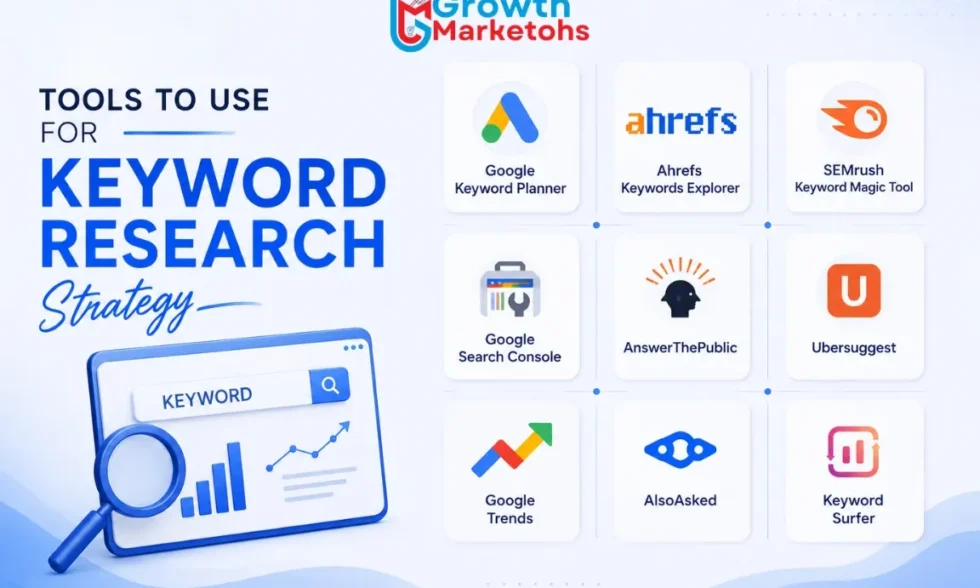
An effective keyword research plan is one founded on facts rather than speculation. Without the appropriate tools, you will not be able to find high-converting keywords, examine the competition, or study search intent. The best SEO tactics are supported by tools that reveal opportunities in keywords, rivalry gaps, search trends, and user actions. No matter what you are creating: content, service pages, or local SEO campaigns, the appropriate keyword tools will make your plan smarter, quicker and more lucrative. These are the most significant tools every business ought to employ to create a smarter keyword research strategy.
1. Google Keyword Planner
The best place to begin developing a keyword research strategy is Google Keyword Planner, since the information is provided by Google. It assists companies to find out search volume, keyword variations, and the level of competition. Although it is primarily intended for Google Ads, it can be highly useful for SEO planning because it is based on actual search patterns.
Best for:
- Basic keyword discovery
- Search volume analysis
- Keyword expansion
- Commercial keyword opportunities
It forms a solid basis for any keyword research.
2. Ahrefs Keywords Explorer
Ahrefs is among the most powerful tools for developing a keyword research strategy because it offers more insights into keywords beyond volume. It displays keyword difficulty, traffic potential, parent topics, and competitors’ rankings. This assists companies in identifying feasible ranking prospects and understanding which words may yield the highest value.
What Ahrefs can do:
- Keyword difficulty analysis
- Competitor keyword research
- Traffic estimation
- Content gap analysis
- Keyword clustering
It is among the most powerful advanced SEO keyword planning tools.
3. SEMrush Keyword Magic Tool
SEMrush provides an extensive database of keywords to help generate more ideas. It is great at identifying variations, long-tail searches, and associated searches. The powerful keyword research plan often uses SEMrush to identify keyword clusters and competitor gaps.
Best uses:
- Long-tail keyword discovery
- Keyword intent filtering
- Competitor keyword tracking
- SERP analysis
It simplifies and accelerates large-scale keyword planning.
4. Google Search Console
Google Search Console is one of the most useful tools that many businesses do not consider when researching keywords, since it indicates which keywords your company is already ranking. This ensures it is effective in enhancing the current pages, as well as in discovering concealed keyword opportunities. Any intelligent keyword research will utilize Search Console information to optimize.
What it reveals:
- Existing keyword impressions
- Click-through opportunities
- Ranking position improvements
- Content optimization opportunities
It helps transform existing visibility into greater growth.
5. AnswerThePublic
AnswerThePublic is very good at identifying questions and users’ search behavior. It assists in creating content based on informational and question-based queries. This tool is part of a robust keyword research strategy that identifies user intent and content opportunities not captured by traditional keyword tools.
Best for:
- Question-based keyword research
- Content topic planning
- User intent analysis
- Blog strategy development
It is particularly handy with content marketing and AEO strategies.
6. Ubersuggest
Ubersuggest is a user-friendly keyword research tool that offers search volume, keyword difficulty, and content ideas. It is applicable to smaller companies or those new to SEO. It is not as powerful as Ahrefs or SEMrush, but it will help with a solid keyword research strategy.
Useful for:
- Basic keyword research
- Competitor insights
- SEO difficulty checks
- Content ideas
It is convenient when one wants to conduct research in a short period and when the campaigns are small.
7. Google Trends
Google Trends can be used to track the popularity of keywords over time and to detect new search trends. This would be significant in the case of seasonal business or a trend-based content strategy. A good keyword research plan involves Trends to confirm the demand and timing.
Best for:
- Trend analysis
- Seasonal keyword planning
- Regional interest tracking
- Emerging keyword opportunities
It helps companies keep up with changes in search behavior.
8. AlsoAsked
AlsoAsked assists in revealing the questions of People Also Ask on Google itself. The tool will be very beneficial in learning about related search behavior and developing content depth. It enhances content strategy and search engine optimization.
Best uses:
- Content expansion
- FAQ planning
- Search intent understanding
- Topic clustering
It is particularly useful in creating authoritative content.
9. Keyword Surfer
Keyword Surfer is a web extension that provides immediate keyword information in search results. When conducting a manual search, it helps determine the volume of search results, relevant terms, and content ideas in a short period. This can be a handy complementary tool for this quick keyword research process.
Conclusion
The key to any successful SEO campaign is a sound keyword research strategy since rankings, traffic, and conversions all start with the proper search intent. Without the right keyword, businesses end up wasting time producing content that appeals to the wrong audience or fails to convert.
The core strength of SEO is its ability to identify keywords that match user intent, business objectives, and purchasing patterns. Growth Markets is where the difference is created.
Growth Marketohs uses data-driven analysis of keywords, competitor analysis, intent mapping, and conversion-driven SEO planning to create powerful keyword systems to enable visibility, qualified traffic, and actual business growth.
At Growth Marketohs, we are your strategic SEO Agency designed to ensure your objective of being smarter, attracting better leads, and making SEO a revenue-generating channel is achieved.
If your business wants smarter SEO growth and better lead generation, work with a trusted SEO expert for business growth today.