Time is of the essence in healthcare. Customers are not window shoppers but are desperate, deliberate, and in need of something now. It is either an emergency hospital near me search or the best orthopedic doctor in Gurgaon; either way, it is a high-stakes, high-conversion search.
This is the issue: at present, most hospitals are either not visible or not running optimally planned campaigns, thus burning budget without real patient enquiries.
That is where PPC for Hospitals beats the game.
Rather than waiting months to rank in search results, PPC enables the hospital to appear at the top immediately, generate demand in real time, and convert users into patients. However, the reality is here: it is not hard to run ads, but it is not easy to run profitable campaigns.
In this guide, we have broken down everything you need to know about PPC for Hospitals, including basics and implementation tips and tricks that will actually result in revenue growth.
About PPC for Hospitals
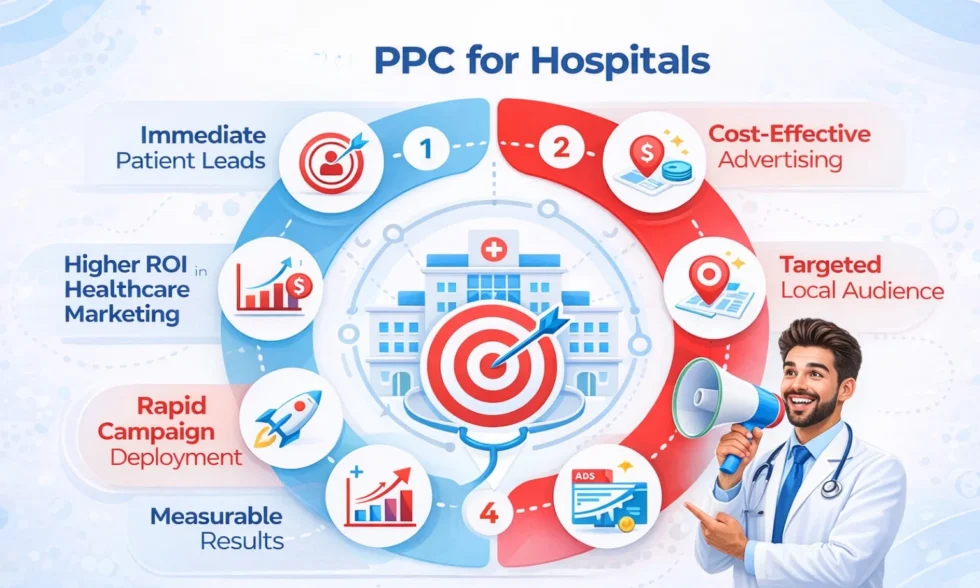
PPC for Hospitals is a performance-based advertising model in which hospitals are charged only when their ad is clicked. These advertisements are posted in:
- Google Search (high-intent queries)
- Google Display Network
- YouTube Ads
- Facebook & Instagram Ads
The whole mechanism is based on a very basic yet effective funnel:
Capture Intent
Patients seek definitive treatment or emergency care.
Deliver Visibility
Your advert is at the top and has a powerful message.
Drive Action
Users click through to a relevant page and become enquiries.
As opposed to traditional marketing, hospital PPC is:
- Immediate
- Measurable
- Scalable
And when properly implemented, it will be a predictable system for patient acquisition.
Benefits of Investing in PPC for Hospitals
When your hospital relies solely on organic visibility or referrals, growth will be slow and erratic. The way PPC for Hospitals works is by developing a system of patient enquiries that are controllable, scalable, and measurable. It enables you to appear at a time when a patient is ready to act.
We are going to deconstruct the actual advantages that make PPC among Hospitals one of the most profitable avenues in healthcare promotion.
1. Immediate Visibility for High-Intent Searches
The patient seeking treatment is not engaging in a search but in a decision-making process.
When using PPC to promote Hospitals, your ads are at the top when the queries include:
- “Emergency hospital near me”
- “Best dentist in [city]”
Impact:
- Instant exposure
- No waiting period like SEO
- Seize demand at the appropriate time.
2. High-Quality Patient Leads
PCP focuses on intentional users rather than on browsing social media.
What this means:
- Better lead quality
- Higher conversion rates
- More pertinent patient investigations.
This renders PPC for Hospitals extremely effective compared to conventional marketing channels.
3. Faster Patient Acquisition
Time matters in healthcare. PPC does not allow you to miss any urgent opportunities.
Results you can expect:
- Gets leads in the days of campaign launch.
- Booking of appointments immediately.
- Reduced idle capacity
This rate renders PPC in Hospitals perfect in scaling at high speed.
4. Full Control Over Budget and Scaling
It is you who determines the amount of expenditure and its location.
Flexibility includes:
- Daily budget control
- Stop or reduce the campaign at any time.
- Invest in the performance services.
The high degree of control of PPC of Hospitals makes it a very manageable and scalable channel.
5. Geo-Targeted Patient Acquisition
Hospitals are situated in particular places, and PPC can be targeted accurately.
You can target:
- Specific cities or areas
- Radius around the hospital
- High-value localities
Outcome:
- Better lead relevance
- Lower wasted spend
6. Measurable ROI and Performance Tracking
Every rupee spent can be tracked.
You can measure:
- Cost per lead
- Conversion rates
- Patient acquisition cost
This renders PPC for Hospitals one of the most open marketing strategies.
Also, read the list of the best PPC agencies in Canada to drive sales for your business.
10 PPC Checklist for Hospitals That Drive More Revenue
The point is that here, advertisements are used by most hospitals, but very few are profitable PPC systems. It is not the budget difference but the execution. A carefully designed checklist of PPC for hospitals will help focus more of the clicks on becoming a patient.
The 10 most critical checkpoints directly affecting revenue, not just traffic, are listed below.
1. Target Only High-Intent Keywords
Not all traffic is valuable. Only search results that suggest immediate action should be paid attention to.
What to do:
- Give preference to near me and treatment-specific keywords.
- Do not be general and informational.
- Get long-tail keywords, as they convert better.
Why it matters:
High-intent keywords will send patients willing to book, making your PPC for Hospitals campaigns profitable.
2. Structure Campaigns by Department or Service
In a single campaign, mixing services makes it less relevant.
Correct structure:
- Individual cardiology, dental, IVF, and orthopedics.
- Specific ad groups for each of the services.
Impact:
Enhances relevance of adverts, reduces cost, and improves conversion rates in PPC among Hospitals.
3. Write Trust-Building, Conversion-Focused Ads
Health care decisions are emotional and trust-oriented.
Include in ads:
- Years of experience
- Advanced facilities
- Location clarity
- Strong CTA
Example:
“Best Orthopedic Services in Gurgaon. Book an appointment.
Enhanced communication enhances CTR and conversions.
4. Use Dedicated Landing Pages (Never Homepage)
Use of the homepage sends the user to the homepage.
Instead:
- Build service-related landing pages.
- Increase page content and advert intent.
Result:
Higher engagement
30–50% better conversion rates
This is an important stage in successful PPC among Hospitals.
5. Optimize for Mobile First
Most medical searches occur on mobile.
Ensure:
- Fast loading pages
- Click-to-call buttons
- Easy-to-fill forms
Impact:
Enhanced user experience has a direct positive impact on the PPC of Hospitals.
6. Implement Geo-Targeting Precisely
Where are your patients, Target?
Strategy:
- 3–10 km radius targeting
- filter to out irrelevant locations.
- Focus on high-value areas
Why it matters:
Enhances lead quality and reduces ad spend wastage.
7. Use Ad Extensions for Better Visibility
The extensions of the ads enhance trust and visibility.
Must include:
- Call extensions
- Location extensions
- Contact page (services) Sitelinks.
Result:
Higher CTR and better PPC performance for Hospitals.
8. Set Up Conversion Tracking Properly
Optimization cannot take place without tracking.
Track:
- Calls
- Form submissions
- WhatsApp clicks
Impact:
You are in the know about what works and where to ramp up your PPC campaigns for hospitals.
9. Run Retargeting Campaigns to Recover Lost Leads
The majority of users do not make their conversion.
Retarget:
- Website visitors
- Ad clickers
Result:
30–60% increase in conversions
Better ROI
Retargeting is an effective PPC layer among Hospitals.
10. Optimize Campaigns Weekly Based on Data
PPC is not “set and forget.”
Regularly optimize:
- Keywords (low performers performers)
- Ad copy (test variations)
- Bids (promotions to employees who perform well)
- Landing pages
Outcome:
Constant enhancement guarantees long-term success.
Tools to Track PPC Campaign Performance for Hospitals
Carrying campaigns is one component of the equation. Having a clear idea of what is working and expanding it is what really drives revenue. This is why tracking is a very important layer in PPC for Hospitals. The correct tools help you understand your patients’ backgrounds, how they conduct themselves, and what will become actual appointments.
The following are the key tools that all hospitals should employ to determine PPC to Hospitals as a profit-making entity.
1. Google Ads Account – Your Core Performance Dashboard
Google Ads is the backbone of any PPC for Hospitals strategy. This is where you track and control everything related to your search campaigns.
What you monitor:
- Cost per click (CPC)
- Cost per lead (CPL)
- Conversion rate
- Keyword performance
- Ad performance
Why it matters:
It shows exactly which keywords and ads are driving patient enquiries, allowing you to scale winning campaigns and eliminate wasted spend.
2. Meta Ads Manager – Audience & Engagement Insights
For Facebook and Instagram campaigns, Meta Ads Manager gives deep insights into audience behavior and ad performance.
Track:
- Reach and impressions
- Click-through rates
- Lead generation performance
- Audience segmentation
Impact:
You can refine targeting, creatives, and messaging to improve lead quality and reduce acquisition costs in your PPC for Hospitals campaigns.
3. Google Analytics – Understand User Behavior
Clicks don’t matter if users don’t convert. Google Analytics helps you understand what happens after someone lands on your website.
Key insights:
- User journey across pages
- Bounce rate and session duration
- Conversion paths
- Landing page performance
Why it’s powerful:
It identifies where users drop off, helping you optimize your funnel and improve ROI in PPC for Hospitals.
4. Microsoft Clarity – Visualize User Interaction
Microsoft Clarity gives a visual layer to your data by showing how users interact with your website.
Features:
- Heatmaps (where users click and scroll)
- Session recordings
- User behavior insights
Result:
You can identify UX issues, confusion points, and friction points—making your landing pages more conversion-focused for Hospitals in PPC.
5. CRM System – Track Leads to Patients
Generating leads is not enough. You need to track how many leads convert into actual patients.
What a CRM does:
- Stores all enquiries
- Tracks follow-ups
- Monitors lead-to-appointment conversion
- Measures revenue generated
Impact:
It connects marketing efforts to actual business outcomes, making your PPC for Hospitals strategy truly ROI-driven.
6. Call Tracking Software – Measure Phone Conversions
In healthcare, a large percentage of conversions occur over the phone.
Tools: CallRail, Knowlarity, Exotel
What they track:
- Number of calls
- Call sources (Google Ads, Meta Ads, website)
- Call duration and quality
Why it’s critical:
It helps you understand which campaigns are driving real patient conversations, ensuring your PPC for Hospitals efforts capture both online and offline conversions.
Conclusion
When your hospital does not appear in the list of hospitals that patients are actively searching, you are losing high-value opportunities daily. PPC to Hospitals is not a simple matter of running advertisements; it is about creating a structure that generates a flow of enquiries, appointments, and revenue.
That is why Growth Marketohs can be considered the most suitable PPC agency in Gurgaon, with its performance-based marketing approach that focuses on actual patient acquisition rather than clicks.
Growth Marketohs, with its established experience in high-intent targeting, conversion-optimized landing pages, and continuous optimization, guarantees predictable growth for hospitals.
If you aspire to conquer local search, minimal acquisition costs, and a high volume of patients, having the right PPC professionals on board is everything.
FAQs
What is PPC for Hospitals?
It is a paid advertising approach in which hospitals appear on search engines and pay only when a user clicks an advertisement, creating enquiries from patients.
What is the lead generation timeline of PPC?
Depending on the launch of PPC campaigns, one can obtain leads in 2-7 days.
What budget is required for PPC?
Budgets differ, and even average budgets could provide high ROI when the campaigns are optimised.
Which platform is best for PPC?
Google Ads is ideal on high intention leads, whereas Meta Ads is ideal on awareness and retargeting.
How do you improve PPC performance?
Through optimization of keywords, advertisements, landing pages and conversion tracking regularly.